
In the sartorial landscape of 2026, the boundary between fashion and fine art has effectively dissolved. We have moved beyond the era of “flat” design, where prints and surface-level embellishments sufficed to convey a narrative. Today’s high-fashion frontier is defined by three-dimensional landscapes—garments that do not merely cover the body but architecturally transform it. Driven by advancements in digital modeling and 3D textile engineering, the modern silhouette has become a playground for the “phygital” aesthetic, where the precision of mathematics meets the raw chaos of nature. This season, the industry is captivated by a singular, striking tension: the intersection of rigid geometric folds and hyper-realistic 3D floral appliqués.
The Geometry of the Fold: Sartorial Origami
The current fascination with geometric folds represents a move toward “Sartorial Origami.” This trend draws heavily from the Japanese philosophy of Ma—the space between objects—using fabric to create voids and cantilevered structures that defy traditional tailoring. Unlike standard draping, which follows the natural curves of the body, geometric folding seeks to impose a new, avant-garde volume.
Structural Integrity and Textile Engineering
To achieve these sharp, boxy structures and accordion-style pleats, designers have turned to high-tech “memory fabrics.” Traditional silks are often too fluid for this level of sculpture; instead, the 2026 runway is dominated by Silk Gazar, Bonded Scuba (Neoprene), and reinforced Starched Linen. These materials act as a canvas for textile engineering, allowing for sharp angles that hold their shape even during the kinetic movement of a runway walk.
Technical Spotlight: The Sculptor’s Toolkit
- Box Pleating: Creating deep, symmetrical folds that provide architectural “pillars” for skirts and bodices.
- Cantilevered Hemlines: Using internal wire or horsehair braids to make fabric extend horizontally away from the body.
- Accordion Manipulation: Repeated vertical folds that create a “shutter” effect, revealing hidden colors or textures as the wearer moves.
The Biomorphic Shift: Hyper-Realistic 3D Florals
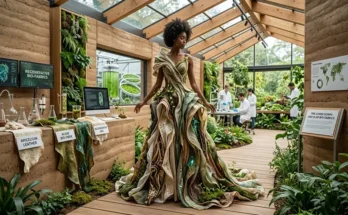
Contrasting the cold, calculated precision of geometry is the rise of the Biomorphic Shift. This is not the floral embroidery of the past; these are 3D floral appliqués that appear to grow organically from the seams of the garment. In 2026, the trend is toward hyper-realism—florals that mimic the translucency, texture, and delicate “veins” of living botanicals.
Materials of the “Living” Garment
The innovation lies in the material composition. Designers are moving away from simple fabric petals toward:
- Laser-Cut Organza: Layered in hundreds of tiers to create the depth of a blooming peony.
- Molded Silicone: Used for “dewy” or succulent-like flowers that have a soft, tactile bounce.
- Recycled PET Plastic: Melted and reshaped into iridescent, glass-like petals that catch the light in a way natural silk cannot.
The magic happens in the placement. Rather than being scattered randomly, these florals are clustered in “growth patterns” around the neck, shoulders, or hips, suggesting that the dress itself is an evolving organism.
The Intersection: Where Hard Meets Soft
The most visionary work of 2026 occurs where these two trends collide. There is a profound visual “friction” when a sharp, geometric shoulder—reminiscent of brutalist architecture—is softened by a cluster of delicate, 3D laser-cut roses.
This convergence redefines the female silhouette. While the geometric folds provide a sense of strength, protection, and futuristic armor, the 3D florals inject a sense of vulnerability and romanticism. It is a dialogue between the Artificial (the fold) and the Natural (the flower). Contemporary visionaries, heavily influenced by the “Biocentrist” movement pioneered by figures like Iris van Herpen, are using digital “slicing” techniques to ensure these two elements feel integrated rather than merely attached. The result is a garment that looks like a digital render brought into the physical world.
Case Studies in Contemporary Vision
We see this trend manifesting in the high-contrast collections of 2026. One notable aesthetic—often referred to as “Bio-Minimalism”—features stark white, architectural gowns where the only “interruption” is a singular, massive 3D-molded lily blooming from a geometric slit in the torso. Other houses are exploring the Schiaparelli-inspired approach: using metallic “liquid silver” folds to form the base of a dress, which is then encrusted with 3D-printed gold floral “growths” that spill down the skirt.
In these cases, the dress is no longer just clothing; it is a kinetic sculpture. The folds create the shadows, and the 3D florals create the highlights, giving the wearer a presence that is impossible to ignore in both physical spaces and high-definition digital media.
The Future: Kinetic Architecture
As we look toward the end of the decade, the next evolution of this trend is Kinetic Sculpture. We are already seeing the first prototypes of “active textiles”—fabrics that use tiny shape-memory alloys (Nitinol) to allow folds to expand or contract based on the wearer’s body temperature.
Imagine a dress where the geometric folds shift and flatten to allow for easier movement, or where the 3D florals literally “bloom” and open their petals when the wearer enters a room with brighter light. In this future, the sculptural dress is not just a static piece of art but a living, breathing partner in the wearer’s self-expression.
Final Takeaway
The 2026 trend of sculptural dress design is a testament to human ingenuity. By blending the mathematical certainty of the geometric fold with the chaotic beauty of the 3D floral, designers are proving that fashion’s primary role is no longer just to clothe, but to inspire awe. We are living in an era where the fabric is the clay, and the designer is the sculptor.