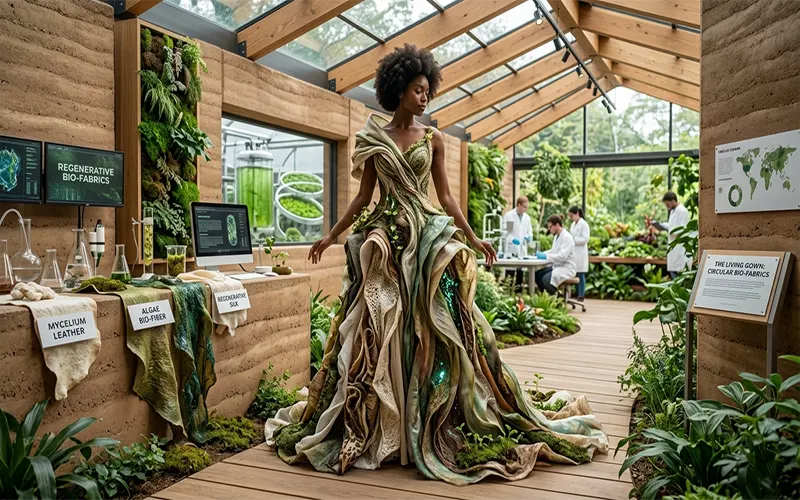
In the high-fashion discourse of 2026, the word “sustainability” has begun to feel like a relic of the past. For decades, the industry aimed for “neutrality”—an attempt to do less harm. However, as the 2026 EU Circular Economy Act takes full effect, the luxury sector has pivoted toward a more ambitious mandate: Regenerative Fashion. We are no longer satisfied with garments that merely “last”; we are demanding dresses that “give back.” High fashion is entering its biological era, where the gown is not just a garment, but a living component of the Earth’s carbon cycle.
Beyond Sustainability: The Regenerative Mandate
The shift to regenerative design represents a fundamental change in the supply chain. While sustainable fashion focuses on reducing footprints, Regenerative Fashion focuses on restoration. This means sourcing fibers from agricultural systems that sequester more carbon than they emit, restore topsoil health, and promote local biodiversity.
In 2026, a high-fashion dress is increasingly judged by its “soil-to-soil” narrative. Designers are no longer just “sourcing” fabric; they are collaborating with biologists and farmers to engineer materials that act as carbon sinks. When a garment’s lifecycle is complete, it does not become waste; it becomes a nutrient, returning to the earth to feed the next generation of fibers.
The Bio-Fabric Gallery: Engineering the Future
The 2026 runways have become showcases for Bio-Fabrication, a process where textiles are grown rather than woven. Three material categories have emerged as the new leaders in luxury couture.
1. Mycelium & Fungal Architecture
Mushroom-based materials have evolved far beyond the “vegan leather” alternatives of the early 2020s. Using Mycelium Architecture, brands like Modern Meadow are now creating sculptural, high-performance dress materials that possess the drape of heavy silk gazar and the durability of fine calfskin.
- The Science: Mycelium (the root structure of mushrooms) is grown in labs on agricultural waste. In 2026, we utilize “liquid tanning” processes—using non-toxic, bio-based enzymes—to achieve a buttery hand-feel that exceeds traditional leather, all while being 100% compostable.
2. Algae & Seaweed Yarns: The “Breathing” Dress
One of the most avant-garde developments this season is the rise of carbon-sequestering textiles made from macro-algae.
- The Tech: These fibers are treated with a living microbial coating that remains active throughout the garment’s life. A dress made from these algae-based yarns literally “breathes,” performing photosynthesis while being worn. It is estimated that wearing one of these gowns for a single gala event can remove as much $CO_{2}$ from the atmosphere as a young oak tree does in a day.
3. Recombinant Silk & Microbial Protein
Traditional sericulture (silk production) has been largely replaced in the luxury sector by Recombinant Silk.
- The Innovation: Companies like AMSilk use bio-engineered bacteria to “brew” silk proteins in fermentation vats. The result is a fiber that mimics the molecular structure of spider silk—offering incredible tensile strength and a light-reflecting luster that synthetic polyesters simply cannot replicate. Because it is lab-grown, it requires 90% less water and zero land-use compared to traditional methods.
Circular Design: The Infinite Silhouette
The beauty of these bio-fabrics lies in their Circular Bioeconomy potential. Designers are now utilizing Enzymatic Recycling, a process where old bio-fiber garments are placed in a microbial “bath” that breaks the fabric down into its base monomers. These monomers are then purified and spun back into virgin-quality yarn, creating an infinite loop of material use without the quality degradation seen in traditional mechanical recycling.
The Digital Product Passport (DPP)
In 2026, every high-fashion bio-dress comes with a Digital Product Passport. By scanning a discreet NFC chip in the hem, consumers can see the garment’s entire lineage: the specific farm where the seaweed was harvested, the lab where the silk was brewed, and the exact “End-of-Life” instructions for return or composting. This transparency has become the ultimate status symbol for the modern, conscious elite.
Case Studies: The Avant-Garde Pioneers
Leading the charge are visionaries like Stella McCartney, who recently debuted a “mycelium-lace” evening gown that used 3D-knitting to eliminate all fabric waste. Meanwhile, innovators like Iris van Herpen continue to push the boundaries of “Bio-Couture,” using 3D-printing with bio-polymers derived from crushed shells and corn husks. These dresses look extraterrestrial—with fluid, kinetic structures that seem to move of their own accord—yet they are biologically native to the planet.
Biotech Glossary
- Carbon Sequestration: The process of capturing and storing atmospheric carbon dioxide.
- Bio-Fabrication: The use of living organisms (cells, proteins, or bacteria) to “grow” materials.
- Closed-Loop: A production system where all waste is recaptured and turned back into raw material.
- Mycelium: The dense, underground network of fungal threads used to create leather-like bio-materials.
The Future: Growing Your Wardrobe
As we look toward the 2030s, the “Living Gown” trend suggests a future where fashion is no longer “purchased” in the traditional sense. We are moving toward a reality where consumers may “grow” their own bespoke bio-dresses in home-based microbial vats using digital blueprints.
By merging the ancient wisdom of nature with the precision of biotechnology, high fashion is finally solving its greatest paradox: how to create something new and beautiful without taking anything away from the earth. The 2026 runway proves that the most luxurious thing you can wear is a garment that helps the planet breathe.