
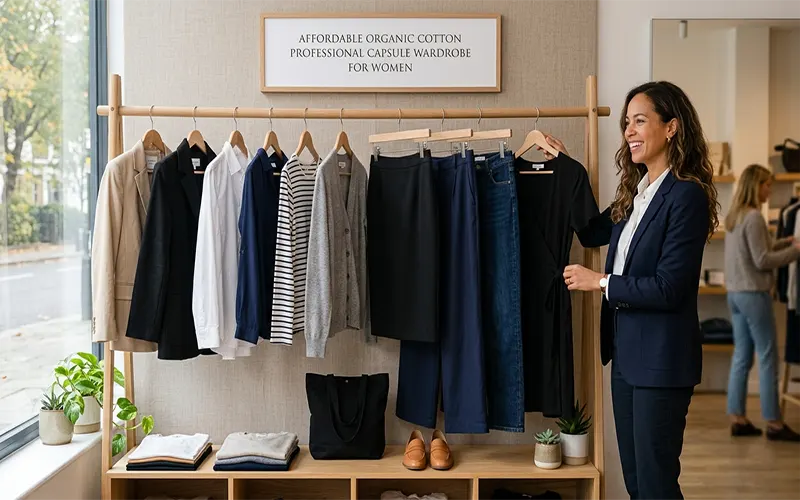
In the evolving landscape of professional attire, the shift toward sustainability is no longer a niche trend—it is a standard for the modern, conscious professional. An organic cotton capsule wardrobe represents the “gold standard” of office wear, balancing sophisticated aesthetics with unmatched functional benefits. Unlike conventional cotton, which is often treated with harsh chemicals, organic cotton offers superior breathability, making it ideal for long hours in climate-controlled offices. It is also inherently more durable due to the lack of chemical weakening during the harvesting process. While “organic” and “sustainable” are often associated with high price tags, building a professional wardrobe from these fibers is increasingly accessible. By focusing on high-quality basics and timeless silhouettes, you can curate a high-end look without the luxury markup.
The “Big Five” Essential Pieces
A successful capsule wardrobe relies on versatility. These five pieces form the foundation of a professional look, utilizing different weights and weaves of organic cotton to suit various formal and casual needs.
1. The Crisp White Button-Down (Poplin)
The cornerstone of any professional closet is the white button-down. For a professional finish, look for organic cotton poplin. Poplin is characterized by a tight, plain weave that results in a smooth, durable, and slightly “crisp” fabric that holds its shape throughout the day.
- Quality Check: Look for “flat-felled” seams and reinforced collars. The fabric should be opaque; if you can see your hand through it, the thread count is likely too low for longevity.
- Styling Tip: For a “Power Casual” look, tuck it into high-waisted trousers and add a leather belt. Roll the sleeves to the mid-forearm to soften the formality.
2. The Tailored Tapered Pant
Moving away from synthetic blends, organic cotton trousers with a hint of natural stretch (or a dense twill weave) provide comfort without sacrificing structure. A tapered leg that hits just above the ankle is a universally professional silhouette.
- Quality Check: Ensure the pockets are lined with cotton rather than cheap polyester, and check the weight of the fabric. It should feel substantial enough to drape elegantly without clinging.
- Styling Tip: Pair these with a tucked-in knit top and loafers for an effortless, chic aesthetic that works from a morning meeting to an evening gallery opening.
3. The Structured Knit Blazer (French Terry or Heavy Interlock)
While traditional wool blazers are common, an organic cotton knit blazer offers a softer, more modern approach. Look for heavy interlock or refined French Terry. These fabrics provide the structure of a jacket with the comfort of a cardigan.
- Quality Check: Examine the lapels; they should lay flat without rolling. High-quality knit blazers will have finished internal seams to prevent stretching.
- Styling Tip: Use this piece to “ground” more casual items. Throw it over a midi dress to instantly signal “office-ready.”
4. The Sophisticated Midi Dress
A midi dress in a medium-weight organic cotton jersey or sateen is the ultimate “one-and-done” outfit. It eliminates decision fatigue while maintaining a high level of professionalism.
- Quality Check: Check the hemline for a blind stitch, which keeps the exterior looking clean and polished. Ensure the neckline is reinforced so it doesn’t lose its shape after washing.
- Styling Tip: Transition this from summer to winter by adding organic cotton tights and an oversized blazer or trench coat.
5. The High-Quality Long-Sleeve Layering Tee
Not all t-shirts are created equal. A professional layering tee should be made from long-staple organic cotton, which resists pilling and has a subtle, silk-like sheen.
- Quality Check: Look for a “ribbed” neckline that won’t sag. The fabric should feel cool to the touch and have a slight “bounce” back when stretched.
- Styling Tip: Wear this under your structured blazer or a sleeveless shift dress. It adds a clean, minimalist layer that keeps the outfit looking intentional.
The Math of “Cost-Per-Wear”
Investing in organic cotton is a financial strategy as much as an ethical one. The “Cost-Per-Wear” (CPW) formula is simple: Total Cost of Item / Number of Times Worn.
A $20 synthetic shirt from a fast-fashion retailer may lose its shape or develop a scent after five washes, resulting in a high CPW. Conversely, a $60 organic cotton shirt that lasts for three years and is worn once a week has a CPW of roughly $0.38. Organic fibers are longer and stronger, meaning they withstand agitation in the wash far better than their conventional counterparts. By spending slightly more upfront, you reduce the frequency of replacement, ultimately saving hundreds of dollars over a three-year cycle.
How to Source Affordably
Building a sustainable wardrobe does not require a thousand-dollar budget. The key is knowing where to look and when to buy.
- The “Affordable-Premium” Tier: Brands like Pact, Quince, and Colorful Standard have revolutionized the market by using direct-to-consumer models. They offer organic cotton basics at prices comparable to traditional mall brands by cutting out the middleman.
- The Secondhand Strategy: Use platforms like Depop, Poshmark, or The RealReal. Search for specific sustainable brands (e.g., Eileen Fisher or Margaret Howell) and filter by “100% Cotton.” You can often find professional pieces in like-new condition for 70% off retail prices.
- Off-Season Logic: Buy your heavy cotton knits in the spring and your light poplin shirts in the autumn. Sustainable brands frequently run “Archive Sales” to clear out past-season colors, providing an excellent entry point for new collectors.
Care & Longevity
To ensure your organic cotton capsule remains in “boardroom” condition, follow these care steps:
- Wash Cold: Heat is the enemy of natural fibers. Washing in cold water prevents shrinkage and preserves the integrity of the cotton’s natural oils.
- Skip the Dryer: Whenever possible, air-dry your professional pieces. High heat breaks down fibers and leads to pilling. Hanging items to dry also helps gravity pull out wrinkles naturally.
- Steam, Don’t Iron: A handheld steamer is gentler on organic cotton than a hot iron, which can sometimes “scorch” or flatten the natural texture of the weave.