In the high-stakes world of luxury fashion, the year 2026 has marked a definitive shift from the aspirational to the algorithmic. For decades, the “standard sizing” model—a relic of mass industrialization—plagued the industry with 30–40% return rates, leading to billions in lost revenue and a mountain of textile waste. But today, a new era of Hyper-Personalization has emerged. Bespoke fashion, once a slow and elitist craft, has been reinvented as “Bespoke 2.0,” a high-speed, data-driven revolution where Agentic Fashion systems ensure that every garment is engineered for the unique topography of a single human body.
The Digital Measuring Tape: LiDAR and Topographical Mapping
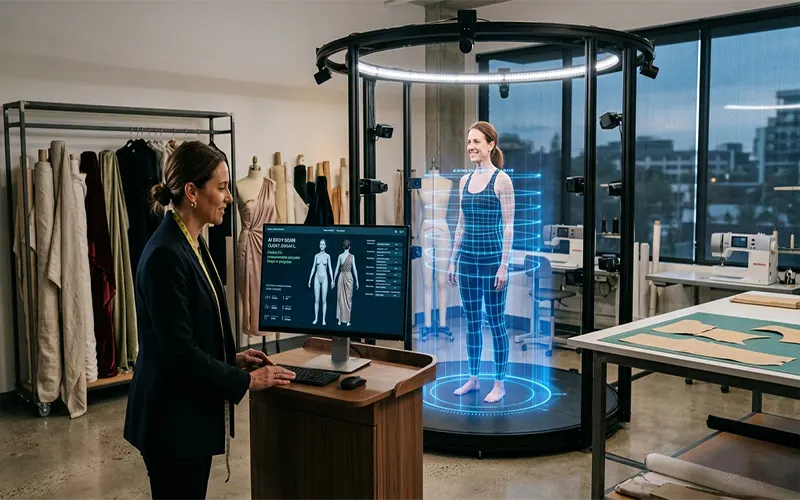
The 2026 sartorial process begins not with a tape measure, but with a LiDAR topographical scan. Leveraging the same light-detection and ranging technology found in autonomous vehicles, modern smartphones now act as high-precision biometric scanners.
When a customer scans their body, the AI doesn’t just record height and weight; it extracts over 200 distinct data points, capturing the precise curve of the spine, the asymmetrical slope of the shoulders, and the specific “stance” of the individual. This data forms a Digital Twin—a high-fidelity mesh that serves as a permanent, private foundation for all future designs.
The Physics of Drape
Perhaps the most significant breakthrough of 2026 is the integration of Textile Physics into the scanning software. AI engines can now predict exactly how a 22-momme silk bias-cut will behave against your specific 3D mesh compared to a structured neoprene. It accounts for “ease” (the space between skin and fabric) and “tension” (how the fabric pulls across the back), ensuring that a digital prototype is a perfect mirror of the eventual physical reality.
The “Agentic” Design Process: From Scan to Pattern
The transition from data to dress is managed by Agentic AI—autonomous systems that take biometric data and automatically “unroll” it into 2D sewing patterns. Platforms like Style3D and 3DLOOK have become the backbone of modern ateliers, allowing designers to reduce physical sampling by up to 70%.
- Pattern Optimization: Traditional grading rules (scaling a size 6 up to a 12) often fail to account for how weight is distributed. AI body scanning allows for inclusive engineering, where patterns are mathematically optimized for the user’s specific volume and bone structure.
- Zero-Waste Prototyping: By perfecting the fit in a 3D virtual environment, designers can eliminate the need for multiple “muslin” fittings. The first time the fabric is cut, it is already the final version.
Brand Spotlight: The 2026 Pioneers
| Brand / Platform | Core Technology | Primary Advantage |
| Style3D | AI Pattern & GPU Rendering | Real-time fabric simulation; reduces lead times from months to days. |
| 3DLOOK | Mobile Body Scanning | Instant 3D avatar creation via two smartphone photos with 95% accuracy. |
| Size Stream | LiDAR Booths & Home Scan | Professional-grade anthropometry for high-end, made-to-measure couture. |
Sustainability & The Circular Loop
Bespoke 2.0 is the fashion industry’s most potent weapon against the climate crisis. In 2026, strict carbon-neutral regulations have made overproduction a legal and financial liability. Made-to-measure on-demand production is the only model that guarantees Zero Overstock.
By only producing garments that already have a “matched” body, brands are eliminating the 92 million tons of textile waste previously generated by unsold inventory. Furthermore, these bespoke pieces are inherently more durable; because they fit perfectly, they experience less mechanical stress on the seams, extending the life of the garment by years.
Privacy Sidebar: Protecting Your Biometric Twin
As body scans are classified as sensitive biometric data under 2026 regulations (such as the updated EU AI Act), top-tier fashion houses now utilize Privacy-by-Design frameworks. Your “Digital Twin” is typically stored using end-to-end encryption or on a localized, sovereign “Digital Passport,” ensuring that your body measurements remain your property, not the brand’s data asset.
The Future: The Living Avatar
Looking toward 2027, the industry is moving toward the “Living Avatar.” Soon, your body twin will live permanently on your mobile device, acting as a sentient filter for global e-commerce. You will no longer “search” for a dress; your AI agent will scan global inventories and show you only the pieces that are guaranteed to fit your exact measurements.
AI body scanning hasn’t replaced the artisan tailor; it has given them a “Super-Tool.” By handling the clinical precision of measurement and fit, technology has freed the human designer to return to what they do best: the high-art of aesthetic storytelling and the soul-work of couture finishing. Bespoke 2.0 is here, and it fits perfectly.